A Book, a Puzzle or a Small Making Project?
Choose a book, puzzle or small making project by the attention, setup and stopping point your day allows, so a quiet afternoon fits your actual mood.
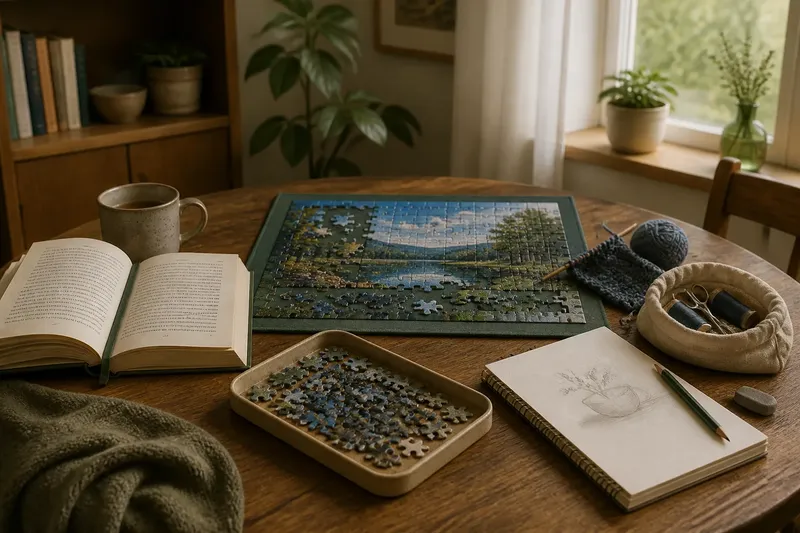
A book, a puzzle or a small making project can all fill a quiet afternoon, but they ask for different kinds of attention. If you are choosing a home pastime, start with the time you can actually give it and the state of mind you are bringing to the table. The best fit may be the one that lets you begin easily, not the one that sounds most appealing in theory.
These activities differ in how they hold your attention, how much they need from the room, and how cleanly you can stop. A novel travels with you from one session to the next. A puzzle stays put and invites you back to a shared visual problem. A small project turns attention into an object, while asking you to manage tools and materials. None is inherently more restful. Each has its own terms.
What kind of attention does each pastime ask for?
Reading is usually the most portable choice. A book needs little more than light, a comfortable place, and enough quiet to follow the thread. It can suit a long spell of concentration, but it can also be divided into short sessions, provided you can find your place again. Fiction may ask you to remember characters and events; essays or short stories can offer more natural stopping points.
A jigsaw puzzle asks for visual attention rather than a continuous narrative. You scan color, shape, edges, and patterns, then compare pieces against a portion of the image. The task is repetitive in a useful way: you can concentrate closely, or let your mind wander while your hands sort. A puzzle is less portable than a book, though, and the unfinished board can keep occupying the table after you leave.
A small making project combines attention with decisions and physical action. Mending a button, sketching a simple still life, or knitting a few rows all ask you to notice what your hands are doing. This can be absorbing, but it is not always passive. You may need to follow a pattern, choose a material, or correct a crooked line. If you want your mind to be entirely off duty, a project with unfamiliar instructions may feel more like an errand.
How much setup can you tolerate?
Books have the lightest setup. Choose something already within reach, rather than spending the first part of your break searching for the perfect title. A bookmark or a folded scrap of paper is enough to mark your place. If the room is busy, a reading lamp or a quieter chair may matter more than the book itself.
Puzzles need a stable surface and a way to keep pieces from wandering. A dining table works if it can stay occupied; a puzzle mat or a shallow tray can help when the table needs to be cleared. Sort pieces only if sorting feels like part of the pleasure. Building elaborate categories before placing anything is optional, not a duty imposed by the cardboard.
Making projects need the most deliberate setup because materials and tools vary. A small sewing repair might call for a needle, thread, scissors, and the garment. A sketch might need paper and a pencil. Set out only what the task requires, and put sharp or delicate tools somewhere sensible when you stop. If an unfamiliar material or tool has specific handling directions, follow its label or manufacturer instructions.
There is a useful distinction between setup that helps you begin and setup that becomes its own hobby. Arranging pencils by color can be pleasant. It is not necessary before drawing one leaf. The same goes for finding a new reading lamp, sorting an entire puzzle, or buying a basket of supplies for a project you have not yet tried.
Which one fits the time you have?
For a brief interval, a book with short chapters or a puzzle already spread out may be easier to enter than a project with several materials to gather. A small making task can fit too, if its next action is obvious: sew on the button, not reorganize the sewing box. The practical question is whether you can spend more of the interval doing the activity than preparing to do it.
For a longer stretch, choose by the kind of continuity you want. Reading carries a thread across pages. A puzzle offers a visible field of possibilities and lets you work in several directions. A project gives you a sequence of small decisions and a tangible result, though that result may take more than one sitting. A free afternoon does not have to become a completion deadline.
Say you have a quiet hour before making dinner, your attention feels scattered, and the dining table will be needed later. A paperback with a clear chapter break may be the least fussy choice. If you would rather use your hands, a small sketch on a single sheet can be put away without leaving a large setup behind. A puzzle spread across the table might be less suitable today, even if you enjoy puzzling in general. The choice follows the afternoon’s constraints, not a permanent ranking of hobbies.
What makes each activity easy to pause?
Books have familiar stopping places: the end of a chapter, a section, or a scene. If none is nearby, a bookmark lets you leave without trying to hold the whole plot in your head. You may prefer a book with shorter sections when interruptions are likely, but any book can be paused; it simply helps to mark the page and, if needed, jot down a character or detail.
Puzzles are naturally open-ended, which can be either their charm or their inconvenience. Before starting, decide where the board can stay and how you will protect it if the surface must be cleared. A tray keeps a small working area together; a puzzle mat can be rolled away, though loose pieces may shift according to its design. If the room must be restored quickly, choose a smaller puzzle or another pastime.
Projects pause best when the work can be left in a state that makes the next action plain. Keep a pattern with the piece, leave a note about the stitch or color you were using, or place the unfinished sketch in a folder. For a task that involves loose parts, a small container can keep them together. The point is not to build a miniature archive; it is to avoid restarting from guesswork.
How do you choose when your mood is mixed?
Low energy does not always mean you want the least demanding activity. You may be tired of screens and still want something for your hands, or restless enough that reading feels difficult. Match the task to the kind of effort that feels tolerable. Reading gives you language and a narrative to follow; puzzling offers repeated visual choices; making asks for action and usually some judgment.
If you want company without much conversation, a puzzle can make a shared surface and a shared focus. Reading is more private, though two people can sit together with separate books. A small project can be companionable if everyone has their own materials or if one person is content to chat while the other works. These arrangements need no special occasion. They do, however, benefit from choosing an activity that does not demand incompatible levels of quiet.
When your mood is hard to name, reduce the cost of changing your mind. Put a book and a pencil beside a clear patch of table, or bring out a puzzle tray without committing to filling it. Start with one natural unit: a few pages, a handful of pieces, one small repair. If the activity catches, continue. If not, stopping is useful information, not a failure to enjoy your day off.
What do readers ask before choosing?
Which pastime is easiest to start?
A book already at hand usually needs the least preparation. A puzzle is easy to start if it is set up and can remain in place, while a making project is simplest when its tools and materials are already gathered.
Which one works best with interruptions?
Books and puzzles can both be paused, but they ask for different kinds of recall when you return. A brief note can help with a dense book; a tray or photograph of the puzzle’s current state can help if the board must be moved.
Which pastime is best if I want to use my hands?
A small making project is the clearest fit, whether that means sketching, mending, or knitting. A puzzle also involves handling pieces, but its main task is to recognize patterns rather than make something new.
Do I need to finish what I start?
No. A book can be set aside, a puzzle can remain unfinished, and a project can stay at a useful stopping point. If unfinished work feels nagging rather than inviting, choose an activity with a natural endpoint for that session.
What is not worth the effort?
It is not worth turning a quiet pastime into a procurement project. You do not need a full set of specialized supplies, a perfect chair, or an elaborate sorting system before you know what kind of attention you want. Borrow a book, use the pencil already in the drawer, or try a puzzle that fits the space you have. Add equipment only when a repeated, specific inconvenience gives you a reason.
It also helps not to confuse visible progress with a good afternoon. A puzzle may look unchanged after a session that felt absorbing; a book may leave no object behind; a repair may be valuable precisely because it becomes unremarkable again. Choose the pastime whose demands suit your available time, energy, interests, company, and room. For a home pastime, that is a better measure than whether you can point to a finished result.